
Dryinject 2000
Semi-rigid polyurethane injection resin, specifically formulated to stop high-flow and/or high-pressure water infiltration
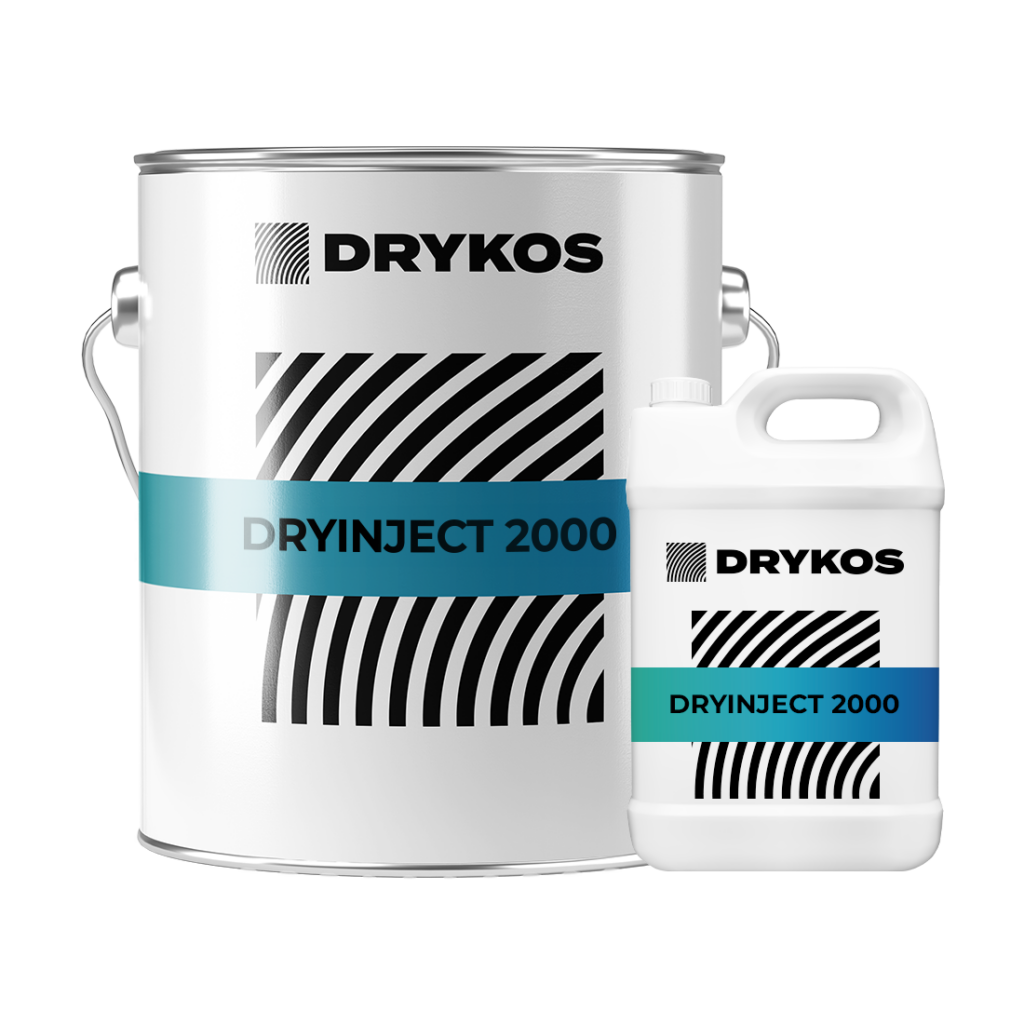
Drykos® Dryinject 2000 is a two-component, solvent-free, semi-flexible hydro-expansive polyurethane resin for sealing water infiltration, both minor and major, in concrete structures and solid masonry through pressure injection. Upon contact with water, Drykos® Dryinject 2000 reacts to form a polyurethane foam that expands up to approximately 20 times its initial volume, enabling effective closure of cracks, cavities, and internal voids.
In the presence of fresh water, expansion reaches the maximum anticipated value; in seawater environments, expansion still occurs, albeit with a slightly reduced volume.
Once the reaction is complete, the polyurethane foam maintains stable volume over time. Good resistance to hydraulic pressure from water ingress is generally achieved within 1–2 minutes from the start of the reaction. The formation of CO₂, typical of the polyurethane reaction, generates additional pressure that promotes resin penetration into cracks, fissures, and cavities, improving sealing effectiveness and ensuring waterproof integrity.
Features
Main features
- Restores structural continuity of concrete or masonry elements compromised by cracking and moisture
- Enables effective consolidation and sealing interventions even in the presence of active water ingress
- Stops infiltration in cracked concrete and masonry structures, even under hydraulic pressure
- Ensures long-lasting seal over time due to the volumetric stability of the expanded foam
- Promotes product penetration into microcracks, improving intervention effectiveness
- Applicable by injection even in complex site conditions or difficult-to-access environments
- Versatile solution for waterproofing and consolidation interventions in civil, industrial, and infrastructure applications
Fields of application
- Stopping and sealing high-flow and/or high-pressure water infiltration in cracks and joints, both static and subject to slight movement
- Blocking water leaks from diaphragms and containment structures
- Filling and consolidating large voids, such as cracks in rock, gravel layers, joints, cracks, and crawl spaces in concrete structures subject to minor settlement or movement
- Performing injections behind segments in underground works and tunnels
- Curtain injections behind porous structures, even in the presence of rapid water flows
Technical specifications
Packaging
Color
Brown.
Appearance
Liquid.
Storage
24 months from production date.
Storage conditions
The product is moisture-sensitive and must be stored exclusively in intact original containers, in a dry and protected environment.
Storage temperature must be between +5°C and +30°C. After opening the package, the material’s useful life is significantly reduced; therefore, it is recommended to use the product as soon as possible.
Application data
Theoretical consumption
Product consumption varies depending on the volume of voids to be filled and substrate characteristics.
Diluent
Polyurethane.
Application temperatures (substrate and environment)
Minimum +8°C | Maximum +35°C
Application info
Substrate preparation
Thoroughly remove dust, dirt, and surface contaminants to correctly assess the extent of the crack or joint to be treated. Active cracks with openings greater than 3 mm must be pre-sealed using the Drykos® Repair system.
Drill holes of appropriate diameter for the selected injector type, at approximately 45° to the surface. Perforations should be distributed along the crack to ensure uniform coverage, particularly when the crack is not perpendicular to the concrete surface.
Hole depth should be approximately half the concrete thickness. Generally, the distance from the drilling point to the crack should equal half the wall thickness. Hole spacing may vary indicatively from 15 to 90 cm, depending on substrate conditions and crack development.
Insert the appropriately sized injector into the hole to approximately 2/3 of its length and tighten by rotating clockwise with a suitable wrench until stable during injection.
Before resin injection, inject water into the crack to remove residual dust and debris, promote substrate cleaning, and improve product penetration. The presence of water inside the crack also enables resin activation.
Product preparation
Before proceeding with injection operations, carefully consult the product Technical Data Sheet and Safety Data Sheet. Always shake the accelerator thoroughly before use. Protect the resin from any contact with water, as moisture can trigger premature reaction inside the container or injection system, causing unwanted hardening or foaming. The resin does not react until it contacts water present in the crack. The use of separate pumps for water and resin is recommended to avoid contamination and possible system blockages.
Pour into a clean container approximately 100 g of component B for each kg of component A (approximately 10% by weight) of Drykos® Dryinject 2000, adjusting the accelerator dosage according to the desired reaction speed and site conditions. Mix the two components thoroughly using a manual tool (do not use drills or electric mixers) until a homogeneous mixture is obtained. Since the resin can also react with ambient moisture, it is recommended to prepare only the strictly necessary quantity, indicatively 2–3 kg of mixture at a time, to reduce waste and premature hardening. Reaction speed can be adjusted by varying the quantity of component B: a dosage above 10% allows reduction of reaction times, to be evaluated based on specific application requirements.
Application
Start injection from the lowest positioned injector.
Begin with minimum pump pressure and increase gradually until the resin begins to flow. Operating pressure may vary indicatively between 40 and 200 bar, depending on crack width, concrete thickness, and general substrate conditions.
Slight resin leakage through the concrete or crack is useful for identifying the product path; excessive leakage should be temporarily plugged. Wait for resin settlement before resuming injection.
During injection, water present in the crack initially flows out, followed by foam formation and finally pure resin discharge. Stop injection when pure resin reaches the next injector, then proceed with it, repeating the same operation.
After injecting through multiple injectors, return to the first point and repeat injection to ensure complete saturation.
At the end of resin injection, water may be injected again into the injectors to promote product hardening in the terminal portion of the holes.
Allow the resin to fully catalyze before removing the injectors. Holes may subsequently be sealed with Drykos® Drymortar waterproof mortar.
Cleaning of tools
At the end of operations, thoroughly clean all equipment and tools that came into contact with the resin using Drykos® Pump Cleaner, preferably within 30 minutes, to prevent product hardening inside the circuits.
Do not use solvents or unsuitable products, as they may be ineffective or create hazardous situations.
Other indications
- Once reacted, Drykos® Dryinject 2000 is physiologically inert.
- The product is packaged under dry nitrogen and is highly sensitive to moisture, including ambient moisture; it is recommended to use small quantities at a time and to carefully reseal containers after use.
- Always verify correct and secure injector fastening before injection. In the presence of inadequately anchored injectors, high operating pressures may cause sudden ejection, with risk of injury to operators.
- Carefully study injector positioning in relation to substrate discontinuities; incorrect positioning or placement too close to the crack may cause concrete or masonry breakage during injection.
- Pay particular attention when using high-pressure electric pumps (up to approximately 200 bar), which may cause unwanted substrate damage if not properly managed.
- Remove any resin residue that has leaked from the masonry within a few hours of stopping infiltration; late removal may be more difficult.
- For matters not covered, contact Technical Support at +39 0171 1874992 or write to [email protected]
Technical performance
Environment and safety
Safety
For information and advice on safety, handling, storage, and disposal, users of the product must refer to the most recent version of the Safety Data Sheet, which provides information on the physical, ecological, and toxicological characteristics of the product. If necessary, request the updated Safety Data Sheet by contacting Customer Service at +39 0171 1874992 or writing to [email protected].
Product compliant with the requirements of Regulation (EC) No. 1907/2006 (REACH) and Annex XVII, entry 47 and subsequent amendments and additions.
Use
Product for professional use.